Hidden Pair Walkthrough
A Hidden Pair is two digits that appear in only the same two cells of a unit. Those cells must hold those two digits, so all other candidates can be stripped from them.
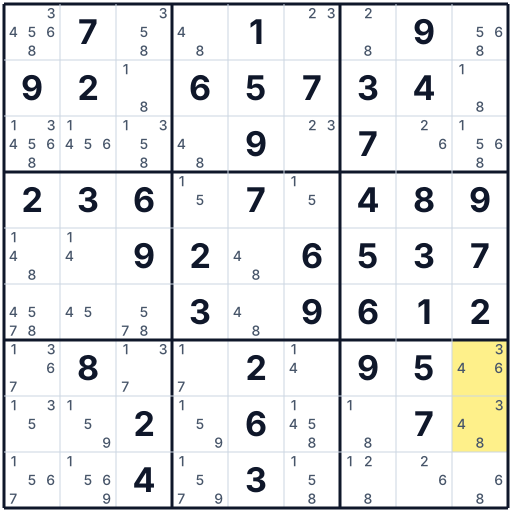
There is a Hidden Pair in Column 9. Applying the Hidden Pair eliminates 2 candidates (struck out in red below; any solved cells shown in green).
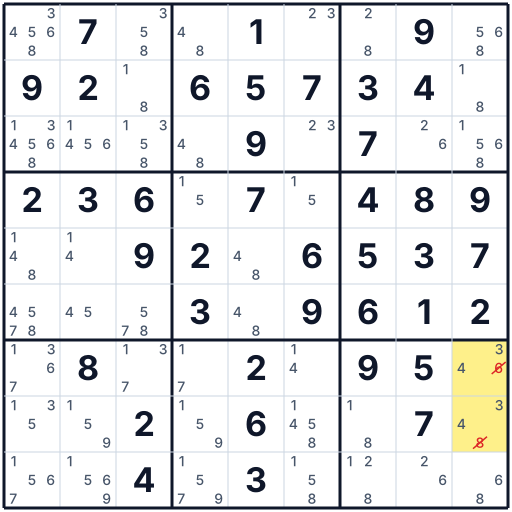
Reading this board
The pattern on this puzzle involves column 9. Work from the before-image above: find the hidden pair for yourself before scrolling to the after-image, since the point of a worked example is the search, not the answer. No cell is solved outright by this move. The value is positional: 2 impossible candidates leave the grid, which is what makes the next round of scanning productive.
Why the deduction is valid
A Hidden Pair is the mirror image of a Naked Pair. Rather than two cells confined to two digits, it is two digits confined to two cells: somewhere in this unit, digit A appears as a candidate in only these two cells, and so does digit B. Since both digits must be placed in the unit and both have only that pair of homes, they take one each. That means every other candidate in those two cells is impossible and can be deleted — the pair is revealed by stripping the clutter away.
How to spot a Hidden Pair on your own board
- Count candidate occurrences per digit within a unit rather than reading cells. Any digit appearing in exactly two cells of the unit is a lead.
- Two such digits sharing the same two cells is the pattern. Tallying the nine digits across one unit takes a few seconds and finds every Hidden Pair in it.
- Boxes tend to hide them best, because a box’s candidates are not laid out in a line where the eye naturally compares them.
Common mistakes
- Deleting the pair digits from the other cells of the unit. That is the Naked Pair action. Here the deletion happens inside the two cells, to everything that is not A or B.
- Giving up because both cells look busy. A Hidden Pair frequently sits in cells showing four or five candidates each — the clutter is what hides it.
What to do next
Once stripped, the two cells now form a Naked Pair, which may license further eliminations in any other unit the two cells share. Check whether they also sit together in a box or line.