Hidden Triplet Walkthrough
A Hidden Triplet is three digits confined to the same three cells of a unit. Those cells must contain those digits, so every other candidate can be removed from them.
Below are 3 positions from real puzzles, each captured when the solver first needs this move. Find the pattern on each before-board yourself, then read the notes and check the after-board, where removed candidates are struck out in red and solved cells shown in green.
Example 1: There is a Hidden Triplet in Column 3
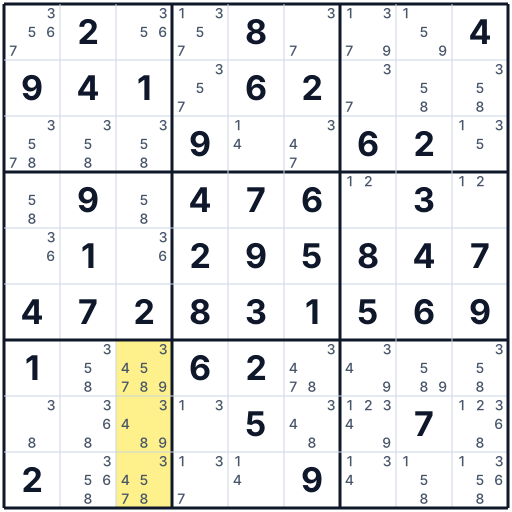
The three bottom cells of column 3 are crowded, with six, four and five candidates, yet 4, 7 and 9 appear nowhere else in the column. That confines those three digits to r7c3, r8c3 and r9c3, so 3, 5 and 8 come out of all three cells, eight candidates in total. The coverage is partial: r8c3 never listed a 7 and r9c3 never listed a 9, and the pattern holds anyway. The same three cells are also a column of box 7, and the triplet holds in the box too.
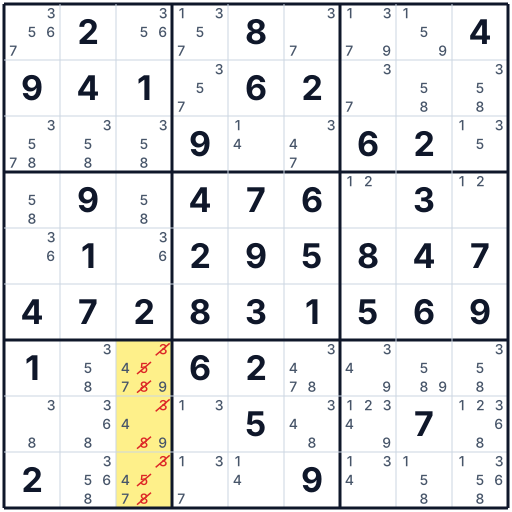
Example 2: There is a Hidden Triplet in Column 2
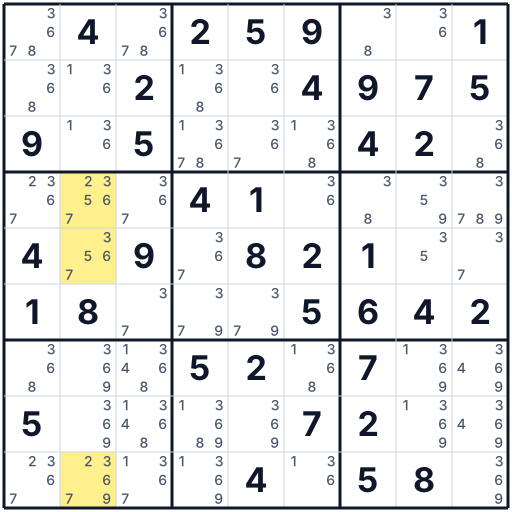
Column 2 has seven open cells, and the digits 2, 5 and 7 are confined to three of them: r4c2, r5c2 and r9c2. Stripping the extras takes 3 and 6 from the first two and 3, 6 and 9 from r9c2, seven candidates in all. There is a second way to see it. The other four open cells, r2c2, r3c2, r7c2 and r8c2, use only 1, 3, 6 and 9, which makes them a Naked Quad. A hidden triplet and a naked quad in the same column are two descriptions of one fact, and you can find whichever is easier to see.
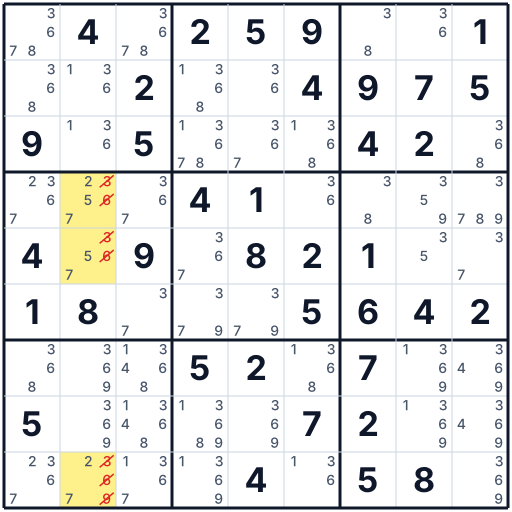
Example 3: There is a Hidden Triplet in Column 2
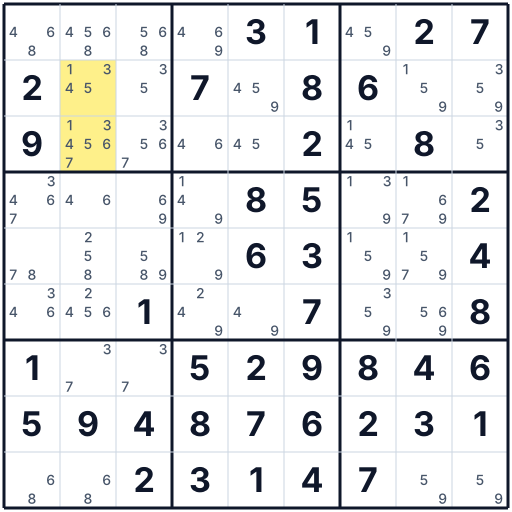
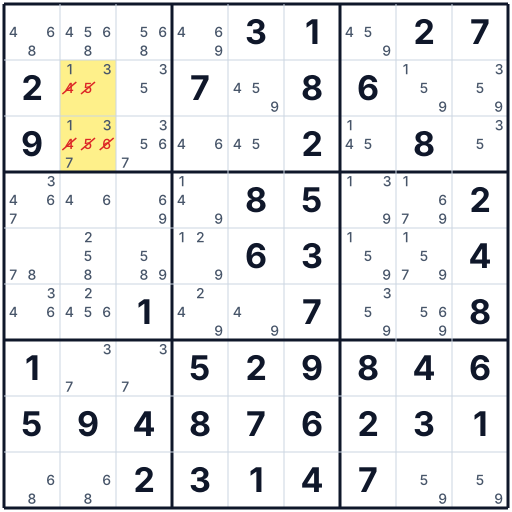
This triplet is spread out: r2c2 and r3c2 are near the top of column 2, and r7c2 is far below in a different box. r7c2 already shows only {3,7}, so every elimination lands in the upper two cells: 4 and 5 from r2c2, and 4, 5 and 6 from r3c2. What is left is worth reading. r2c2 becomes {1,3} and r3c2 {1,3,7}, and the 1 of column 2 is now a choice between those two cells.
Why the deduction is valid
Three digits whose only homes in a unit are the same three cells must fill those three cells between them. As with the Hidden Pair, the deduction runs from the digits to the cells rather than the other way round, and the payoff is that every other candidate inside those three cells can be removed. None of the three digits needs to appear in all three cells — the pattern only requires that none of them appears anywhere else in the unit.
How to spot a Hidden Triplet on your own board
- Tally the unit: for each digit still missing, note which cells could hold it. Digits with only two or three possible cells are candidates for the pattern.
- Look for three such digits whose combined footprint covers exactly three cells. That footprint is the triplet.
- This is the technique where systematic tallying beats intuition. Hidden Triplets are close to invisible by eye, because the defining evidence is what is absent from the rest of the unit.
Common mistakes
- Requiring each of the three digits to appear in all three cells. Partial coverage is normal and still valid.
- Stopping after removing the extra candidates without re-reading the unit — the strip usually exposes Naked Singles or a Naked Pair immediately.
What to do next
After the extra candidates come out, the three cells behave as a Naked Triplet. If they share a second unit, apply the triplet’s eliminations there too.