Naked Pair Walkthrough
A Naked Pair is two cells in the same unit that hold the same two candidates and nothing else. Those two digits are locked into those cells, so they can be removed from every other cell in the unit.
Below are 3 positions from real puzzles, each captured when the solver first needs this move. Find the pattern on each before-board yourself, then read the notes and check the after-board, where removed candidates are struck out in red and solved cells shown in green.
Example 1: There is a Naked Pair in Row 8
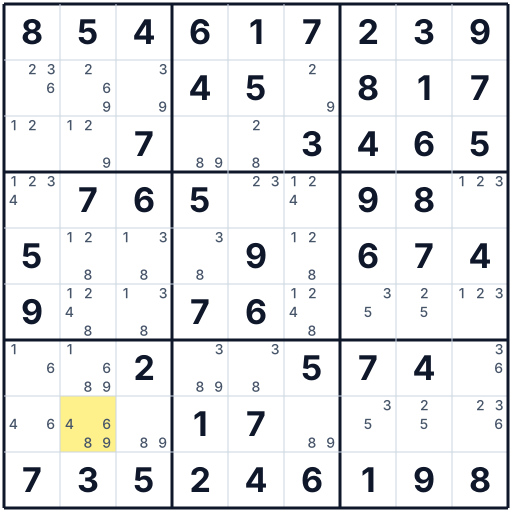
Row 8 has seven open cells, and two of them, r8c3 and r8c6, show exactly {8,9}. They are in different boxes, so this pair acts along the row only. Between them they must take the 8 and the 9. The only other cell in the row still listing either digit is r8c2, which drops from {4,6,8,9} to {4,6}. That is two eliminations and no placement, which is the normal yield of a pair. The follow-up is the interesting part: r8c2 now matches r8c1 {4,6}, so row 8 holds a second Naked Pair, and that pair takes the 6 out of r8c9.
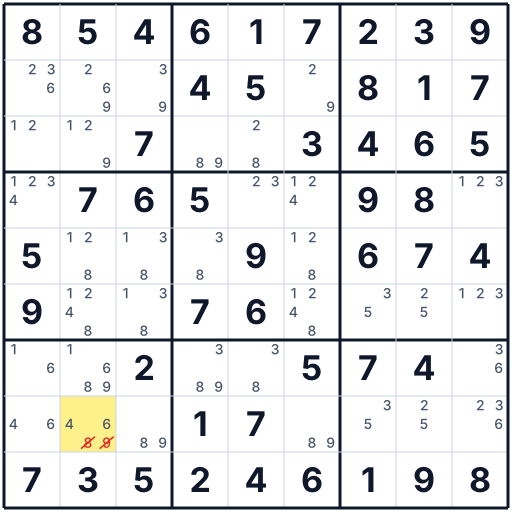
Example 2: There is a Naked Pair in Column 3
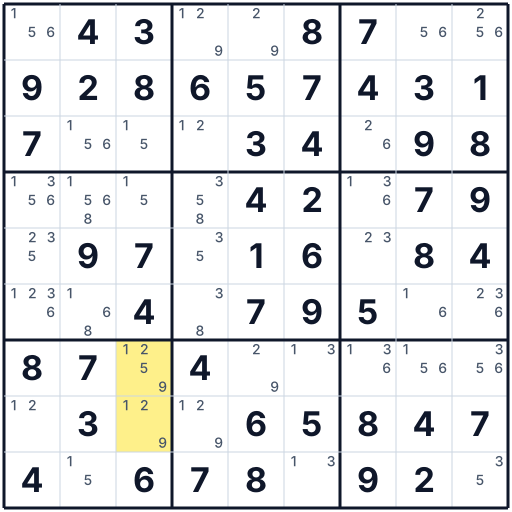
The pair in column 3 is r3c3 and r4c3, both {1,5}. Row 3 belongs to box 1 and row 4 to box 4, so the two cells share only the column. Clearing 1 and 5 from the rest of column 3 changes two cells near the bottom. r7c3 goes from {1,2,5,9} to {2,9}, and r8c3 from {1,2,9} to {2,9}. That creates a new {2,9} pair in r7c3 and r8c3, and because those two cells also share box 7, the new pair works in two units at once.
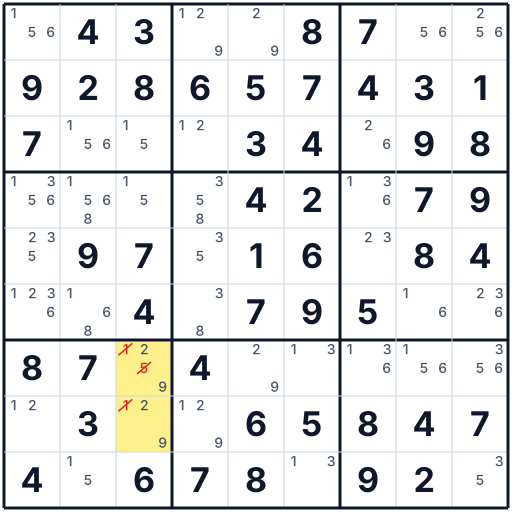
Example 3: There is a Naked Pair in Block 2
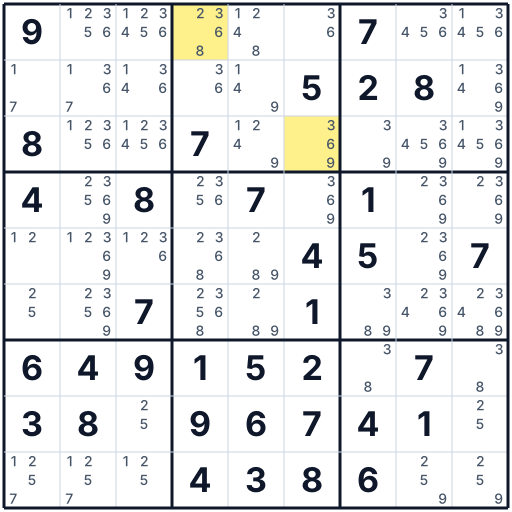
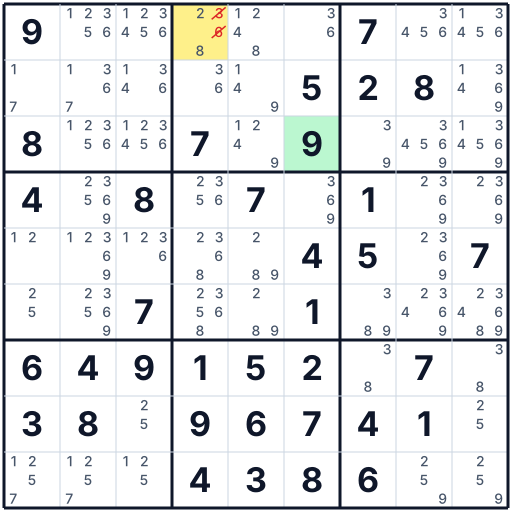
This pair lives in a box rather than a line. r1c6 and r2c4 both show {3,6}, and they share box 2 but neither a row nor a column. Taking 3 and 6 out of the rest of the box changes two cells. r1c4 drops from {2,3,6,8} to {2,8}, and r3c6 loses both of its extra candidates and is solved as 9. Of the three Naked Pair examples, this is the only one where the pair places a digit directly.
Why the deduction is valid
When two cells in the same unit show only the same two candidates, those two digits have to occupy those two cells in one order or the other. You do not know which arrangement is correct and you do not need to: either way, both digits are used up inside that pair. Every other cell in the unit is therefore barred from both, even though nothing has actually been solved yet. This is the first technique that produces eliminations without producing a placement, which is why it feels different from singles.
How to spot a Naked Pair on your own board
- Scan for cells holding exactly two pencil marks, then check whether any other cell in the same row, column or box shows that identical pair.
- The two candidates must match exactly. {2,7} and {2,7} is a Naked Pair; {2,7} and {2,7,9} is not.
- Work unit by unit rather than roaming the grid. Take one row, list its two-candidate cells, compare them, then move to the next row.
Common mistakes
- Eliminating inside the pair itself. The two digits stay in those two cells — you strip them from the other cells of the unit, never from the pair.
- Missing the second unit. If both cells of the pair happen to share a box as well as a row, the eliminations apply along both, and solvers routinely take only the obvious one.
What to do next
Naked Pairs rarely solve a cell directly. Their value is that the eliminations often reduce some third cell to a single candidate, so immediately re-scan the unit you just cleaned for Naked and Hidden Singles.