Naked Quad Walkthrough
A Naked Quad is four cells in a unit whose candidates come from only four digits. Those digits are locked into the four cells and can be eliminated from the rest of the unit.
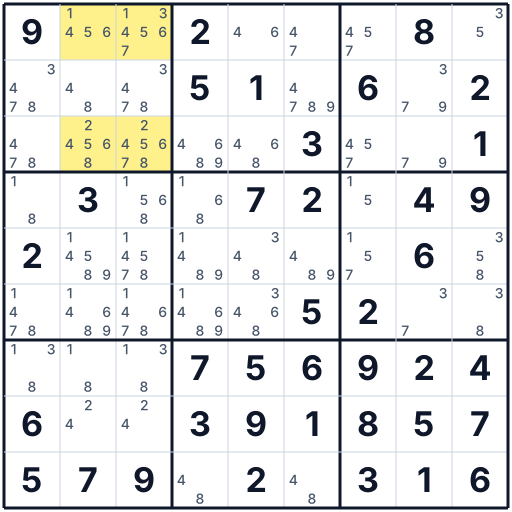
There is a Naked Quad in Block 1. Applying the Naked Quad eliminates 9 candidates (struck out in red below; any solved cells shown in green).
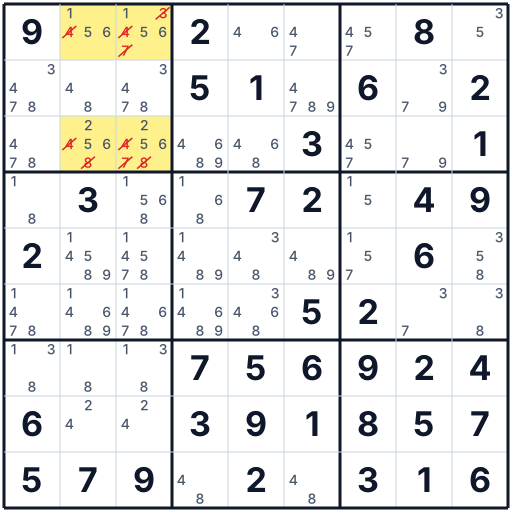
Reading this board
The pattern on this puzzle involves box 1. Work from the before-image above: find the naked quad for yourself before scrolling to the after-image, since the point of a worked example is the search, not the answer. No cell is solved outright by this move. The value is positional: 9 impossible candidates leave the grid, which is what makes the next round of scanning productive.
Why the deduction is valid
Four cells drawing on only four digits between them must use all four, locking those digits out of the rest of the unit. The logic is identical to the pair and the triplet — n cells confined to n digits consume all n — but at size four the pattern is harder to see, since the four cells may show any mix of two, three or four candidates each.
How to spot a Naked Quad on your own board
- Only look for quads in units that are already well filled. A unit with five or fewer empty cells is where a quad can actually exist and be useful.
- Take the union of candidates across four cells; a union of exactly four digits is the pattern.
- If a unit has exactly five empty cells and four of them form a quad, the fifth cell is immediately a Naked Single — that is usually the quickest way to notice one.
Common mistakes
- Hunting for quads before exhausting pairs and triplets. Almost every quad is preceded by a cheaper deduction elsewhere on the board.
- Miscounting the union. Four cells covering five digits is not a quad, and it is an easy slip when the cells hold different subsets.
What to do next
Quads usually appear near the end of a puzzle and tend to finish the unit outright. Re-scan the unit and the boxes it crosses for the singles the eliminations have created.