Naked Single Walkthrough
A Naked Single is a cell left with only one possible candidate once the digits already in its row, column, and 3x3 box are eliminated. That digit must go there.
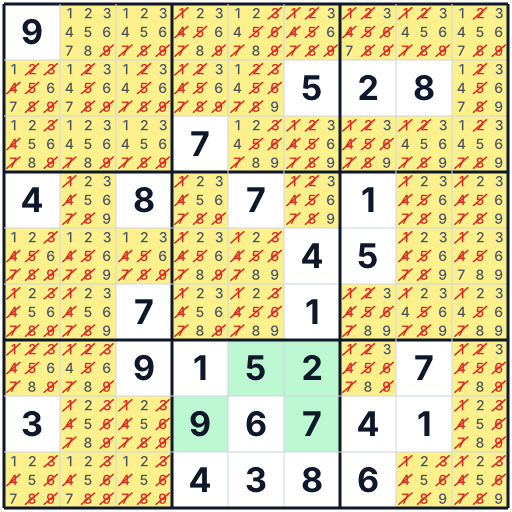
Below are 3 positions from real puzzles, each captured when the solver first needs this move. Find the pattern on each before-board yourself, then read the notes and check the after-board, where removed candidates are struck out in red and solved cells shown in green.
Example 1: There is a Naked Single in Row 1, Column 7
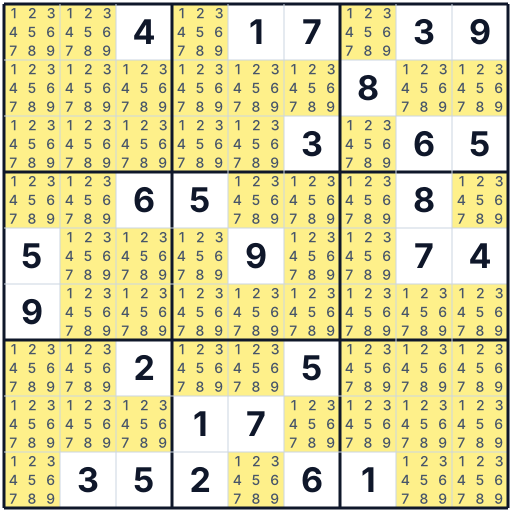
This is the puzzle as it starts, with 26 givens, so every empty cell in the before-image still lists all nine candidates. That is why the after-image strikes out 299 of them: it shows the grid being pencilled in, not one clever move. Look at r1c7. Its row already holds 1, 3, 4, 7 and 9, column 7 adds an 8, and the top-right box contributes 5 and 6. Eight different digits are visible from that one cell, which leaves 2. It is the only cell on this board that pencilling in reduces to a single candidate.
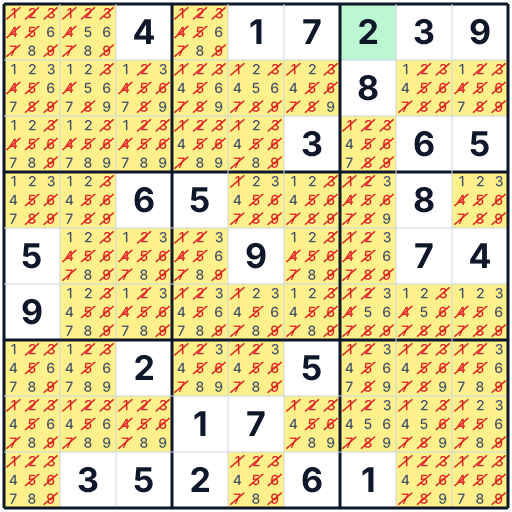
Example 2: There is a Naked Single in Row 2, Column 1
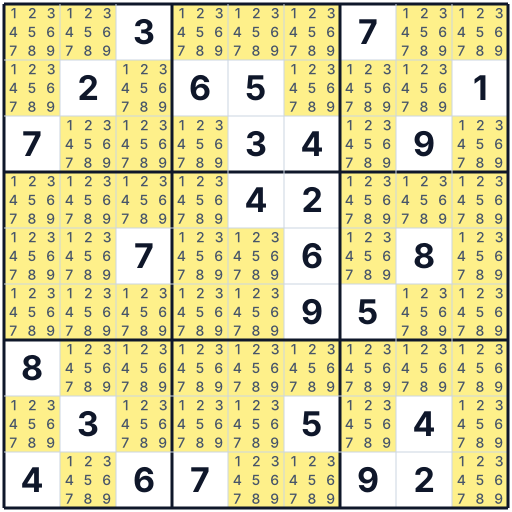
Another untouched opening grid with 26 givens, but a much more generous one. Pencilling in leaves five cells with a single option: r2c1, r2c8, r5c5, r6c5 and r9c5. For the named cell, r2c1, row 2 supplies 1, 2, 5 and 6, column 1 supplies 4, 7 and 8, and box 1 adds the 3. Only 9 is left. Three of the five singles fall in column 5, so once you have found one of them, read the rest of that column before you go anywhere else.
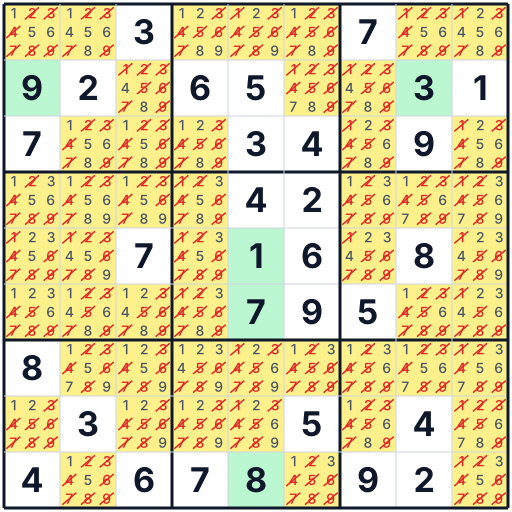
Example 3: There is a Naked Single in Row 7, Column 6
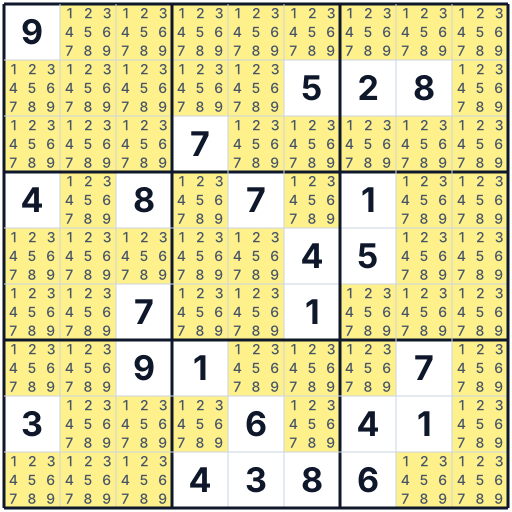
The thinnest of the three starting grids, with only 24 givens, and its singles all sit in one place. Box 8 starts with five givens (1, 3, 4, 6 and 8), and pencilling in solves all four of its empty cells: r7c5, r7c6, r8c4 and r8c6. The named one, r7c6, sees 1, 7 and 9 along row 7 and 1, 4, 5 and 8 down column 6, and the box rules out 3 and 6. That leaves 2. When a box is that full, its remaining cells are worth checking before anything else on the board.
Why the deduction is valid
A Naked Single is the point where elimination has already done all the work. Every digit but one has been ruled out of the cell by something visible in its row, its column, or its box, and Sudoku guarantees each cell holds exactly one digit. So the survivor is not a good guess — it is the only legal occupant, and writing it in is a certainty rather than a commitment.
How to spot a Naked Single on your own board
- Work the cells with the fewest pencil marks first. If you keep candidate notation at all, a Naked Single is literally a cell displaying one mark, so it is found by looking rather than reasoning.
- After every digit you place, re-check the three units that digit sits in. Placing a digit removes a candidate from up to twenty other cells, and the cell that was down to two marks is now down to one.
- Without pencil marks, scan the fullest rows, columns and boxes. A unit with seven digits already placed leaves each empty cell in it with very few survivors.
Common mistakes
- Hunting for exotic patterns while Naked Singles sit unclaimed. Advanced techniques exist to create singles; if singles are already available, the advanced move is wasted effort.
- Forgetting that a placement cascades. Solvers often place one digit, then resume scanning from the top of the grid instead of from the cell they just filled, which is where the next single almost always is.
What to do next
Placing a Naked Single usually creates more of them. Follow the chain until it dries up completely before you go looking for anything harder — most easy and medium puzzles are nothing but one long cascade of singles, and even the hardest puzzles collapse into a cascade once their one difficult step is found.