Naked Triplet Walkthrough
A Naked Triplet is three cells in a unit whose candidates are drawn from the same three digits. Those digits are confined to those three cells and can be cleared from the rest of the unit.
Below are 3 positions from real puzzles, each captured when the solver first needs this move. Find the pattern on each before-board yourself, then read the notes and check the after-board, where removed candidates are struck out in red and solved cells shown in green.
Example 1: There is a Naked Triplet in Row 6
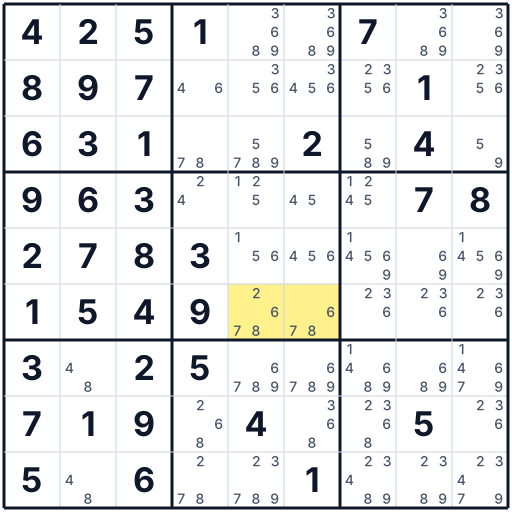
This is the textbook form, and it is less common than you might expect: r6c7, r6c8 and r6c9 each show all three of {2,3,6}. Along row 6 the triplet clears 2 and 6 from r6c5 and 6 from r6c6. Both cells end up as {7,8}, and since they sit side by side in box 5, that is a fresh Naked Pair in the row and in the box. Three cells showing the same three candidates are the easiest triplet to see, and that tidy shape is the exception on real boards.
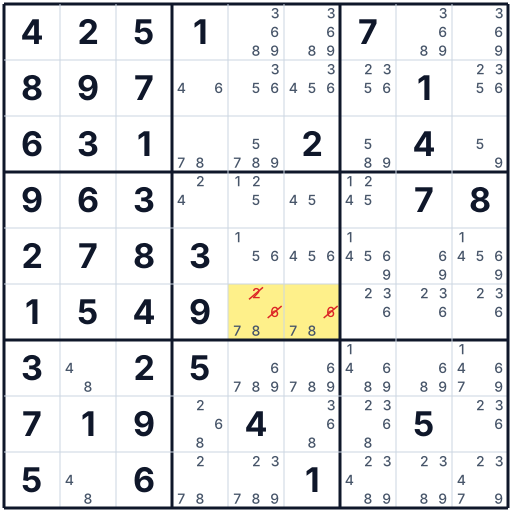
Example 2: There is a Naked Triplet in Row 9
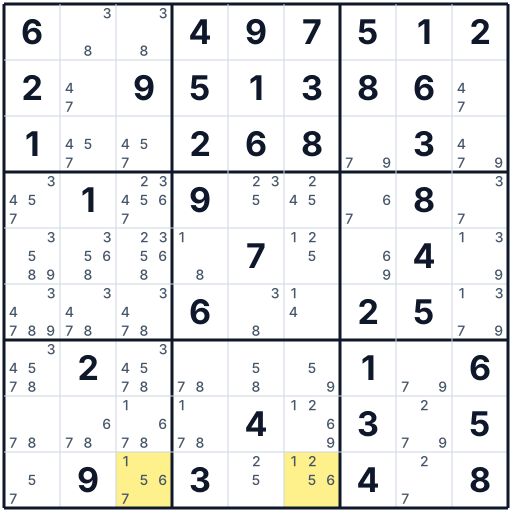
No cell in this triplet shows all three digits. In row 9, r9c1 {5,7}, r9c5 {2,5} and r9c8 {2,7} interlock in a ring, and together they use only {2,5,7}. They are spread across boxes 7, 8 and 9, so they can only act along the row. r9c3 loses 5 and 7, r9c6 loses 2 and 5, and both end up as {1,6}. That leaves row 9 holding two structures at once, the ring of three and a new {1,6} pair.
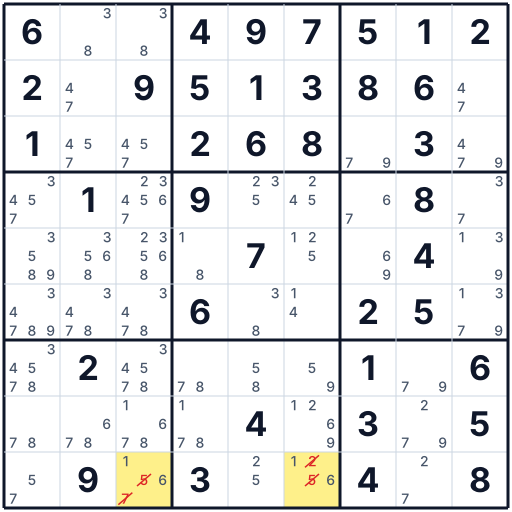
Example 3: There is a Naked Triplet in Block 2
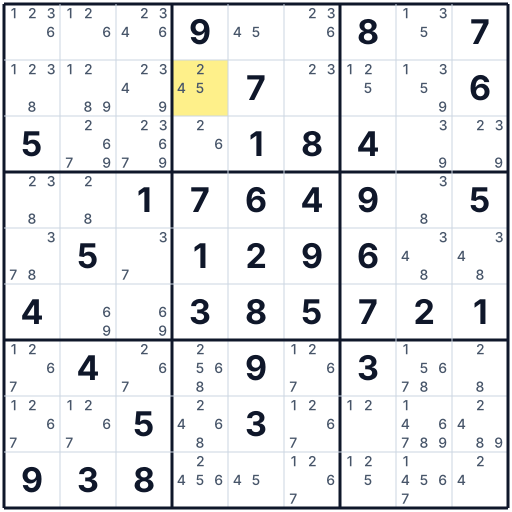
A box triplet with cells of different sizes: r1c6 shows {2,3,6}, r2c6 {2,3} and r3c4 {2,6}. Only one candidate falls, the 2 in r2c4, which becomes {4,5}. One elimination looks like a small result, but r2c4 now matches r1c5 {4,5}, a Naked Pair that is also in box 2. With the triplet and the pair together, all five open cells of the box are accounted for.
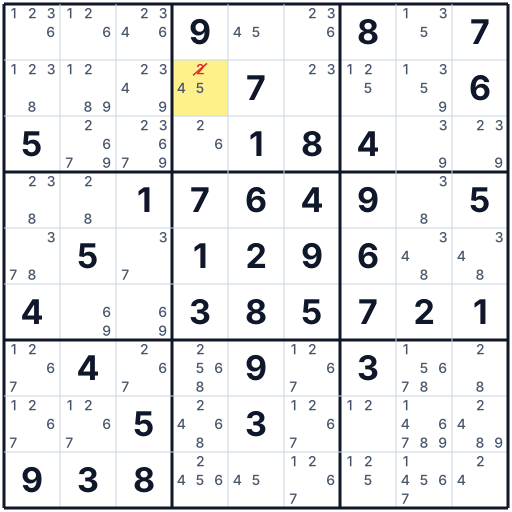
Why the deduction is valid
Three cells in a unit whose candidates are drawn from the same three digits must consume all three of those digits between them. The subtlety is that the individual cells need not show all three — {1,4}, {4,9} and {1,9} is a perfectly good Naked Triplet, because those three cells still have nowhere to go outside the set {1,4,9}. Three cells, three digits, no room for anything else: the digits are locked in, and clear out of the rest of the unit.
How to spot a Naked Triplet on your own board
- Look for clusters of cells in one unit whose candidates all come from a small pool. Take the union of three cells’ candidates; if the union has exactly three members, you have a triplet.
- The partial forms are the ones people miss. Two-candidate cells that interlock in a ring, like {3,6}, {6,8}, {3,8}, are far more common than three cells each showing all three digits.
- Units already holding five or six placed digits are the best hunting ground, since few candidates remain to form the pool.
Common mistakes
- Counting a union of four digits as a triplet. Three cells covering four candidates locks nothing.
- Overlooking that the triplet may span a box as well as a line, in which case the eliminations apply in both units.
What to do next
Triplets often unlock the unit dramatically, since removing three digits from the remaining cells can leave several of them with one candidate each. Sweep the whole unit for singles before moving on.