Omission Walkthrough
Omission (Locked Candidates) occurs when, within a box, a candidate is confined to a single row or column. The digit must fall on that line, so it can be eliminated from the rest of that row or column.
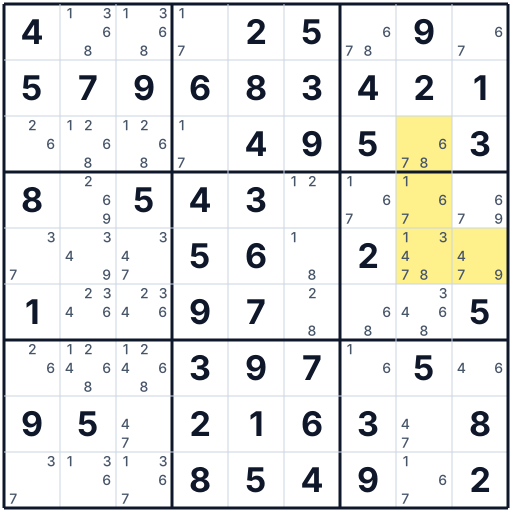
Omission can be applied between Row 5 and Block 6. Applying the Omission eliminates 4 candidates (struck out in red below; any solved cells shown in green).
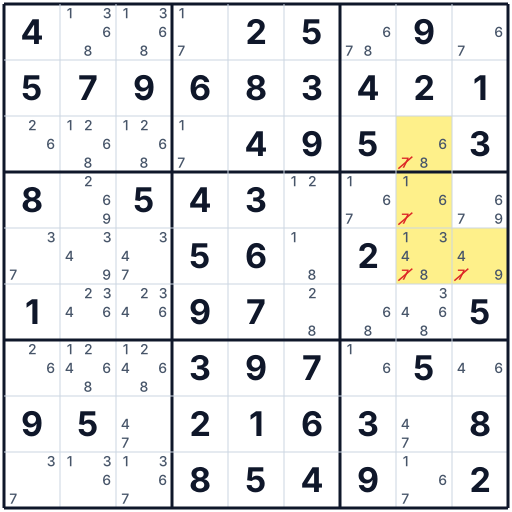
Reading this board
The pattern on this puzzle involves the highlighted cells. Work from the before-image above: find the omission for yourself before scrolling to the after-image, since the point of a worked example is the search, not the answer. No cell is solved outright by this move. The value is positional: 4 impossible candidates leave the grid, which is what makes the next round of scanning productive.
Why the deduction is valid
Omission — also called Locked Candidates, or pointing and claiming — exploits the overlap between a box and a line. If every cell in a box that could hold a digit lies in the same row, then that digit is somewhere in that row no matter which of those cells it turns out to be, so it can be eliminated from the rest of the row outside the box. The same argument runs in reverse: if a digit within a row can only appear in the cells that fall inside one box, it is eliminated from the rest of that box.
How to spot a Omission on your own board
- For each box, take one missing digit and mark every cell that could hold it. If they all share a row or column, you have a pointing elimination along that line.
- For the reverse direction, take a row or column and a digit missing from it. If the digit is confined to the two or three cells the line shares with one box, clear it from the rest of that box.
- Two cells in line is the common case; three in line inside a single box is the strongest version and clears six cells at once.
Common mistakes
- Applying the elimination to the wrong side of the overlap. Pointing clears the line outside the box; claiming clears the box outside the line. Deleting inside the intersection is always wrong.
- Only ever checking rows. Half of all Omissions run down columns, and solvers who scan horizontally by habit find roughly half the pattern.
What to do next
Omission is the highest-yield technique per unit of effort on medium and hard puzzles, and it is usually the rung people are missing when a puzzle stalls. Once the line is cleared, look for Hidden Singles in it — the elimination often leaves a digit with exactly one home.