Swordfish Walkthrough
A Swordfish is the three-line version of the X-Wing: a candidate confined to the same three columns across three rows (or vice versa). It can then be eliminated from those columns outside the three rows.
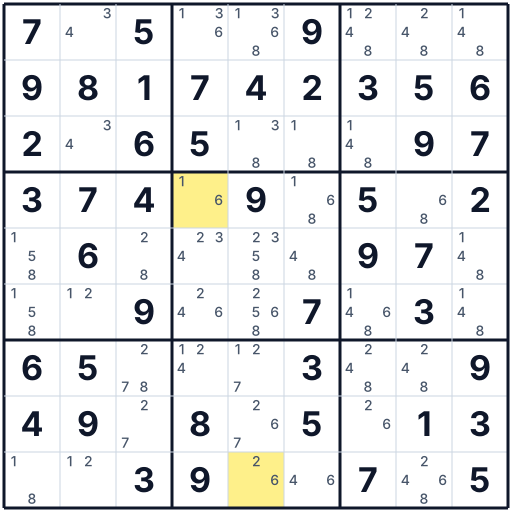
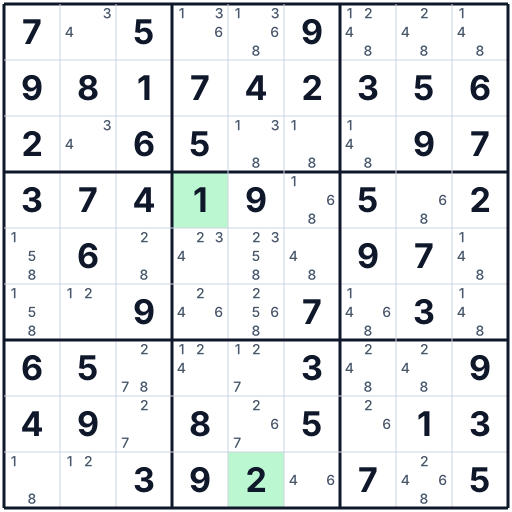
There is a Swordfish with the number 6. Applying the Swordfish places 2 digits (struck out in red below; any solved cells shown in green).
Reading this board
The pattern on this puzzle involves the candidate 6. Work from the before-image above: find the swordfish for yourself before scrolling to the after-image, since the point of a worked example is the search, not the answer. No cell is solved outright by this move. The value is positional: 0 impossible candidates leave the grid, which is what makes the next round of scanning productive.
Why the deduction is valid
A Swordfish is an X-Wing scaled up by one. Instead of two rows and two columns, a digit is confined within three rows to cells that between them occupy only three columns. Each of the three rows must place the digit somewhere in those three columns, and there are exactly three columns to receive three placements, so each column takes precisely one. The digit can therefore be eliminated from every other cell in those three columns. Crucially, the rows do not each need all three columns — two of the three is enough, which is what makes the pattern hard to see.
How to spot a Swordfish on your own board
- Pick a digit and map its remaining candidates grid-wide. Look for rows where it has only two or three possible cells; ignore rows where it is still wide open.
- Take three such rows and read off the set of columns they use. If that set contains exactly three columns, you have a Swordfish.
- Then repeat with the axes swapped: three columns confined to three rows eliminates along the rows.
- Because the rows may use only two of the three columns each, the pattern rarely looks like a tidy nine-cell grid. Work from the column count, not from the shape.
Common mistakes
- Insisting on a full three-by-three arrangement. Most genuine Swordfish are ragged, with two candidates in some rows and three in others.
- Allowing a fourth column to sneak in. Three rows spanning four columns proves nothing at all.
- Attempting it before checking for an X-Wing on the same digit — the smaller pattern is more common and much cheaper to verify.
What to do next
A Swordfish is usually the single hard step a difficult puzzle is built around. Once its eliminations are in, the grid typically reopens to singles and pairs, so go straight back to basic scanning rather than looking for another advanced pattern.