Hidden Quad Walkthrough
A Hidden Quad is four digits that appear only within the same four cells of a unit. Those cells are reserved for those digits, so other candidates can be cleared from them.
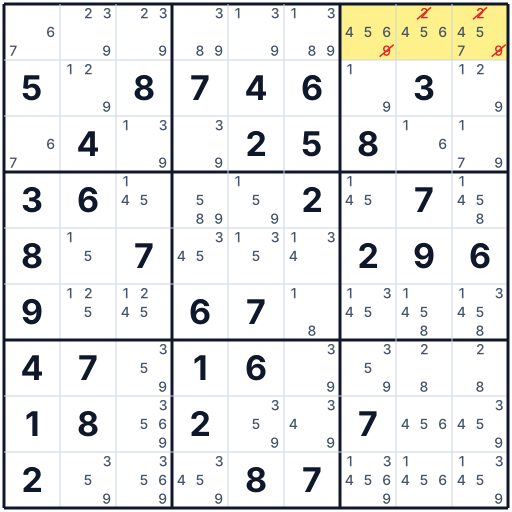
Below are 3 positions from real puzzles, each captured when the solver first needs this move. Find the pattern on each before-board yourself, then read the notes and check the after-board, where removed candidates are struck out in red and solved cells shown in green.
Example 1: There is a Hidden Quad in Row 1
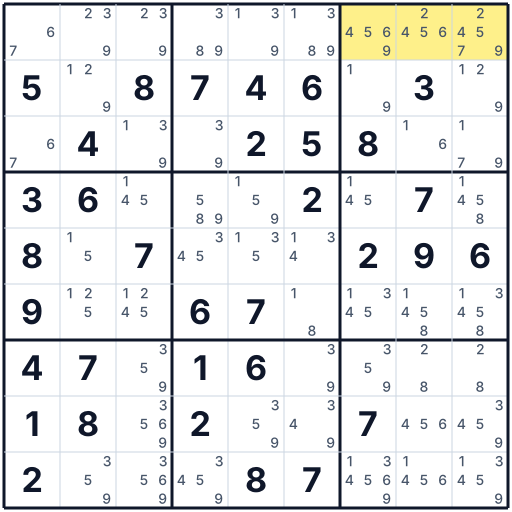
All nine cells of row 1 are still open here, the wide-open kind of unit where hidden quads tend to turn up. The digits 4, 5, 6 and 7 can only go in r1c1, r1c7, r1c8 and r1c9. So those four cells are reserved, and their other candidates go: 9 from r1c7, 2 from r1c8, and 2 and 9 from r1c9. r1c1 shows only {6,7} already and does not change. Read the other way, the five cells r1c2 to r1c6 use only 1, 2, 3, 8 and 9, which is the same fact described from the opposite side.
Example 2: There is a Hidden Quad in Row 7
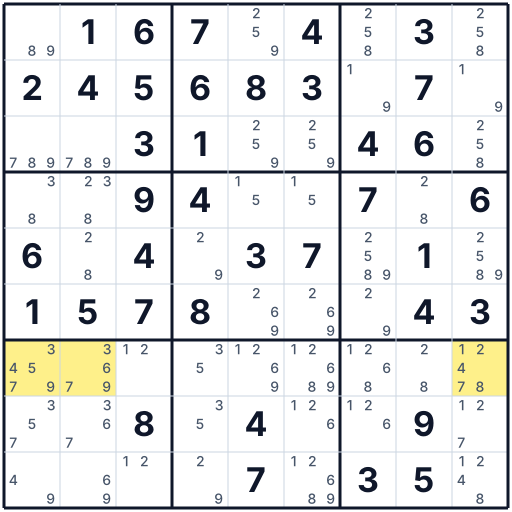
Row 7 is completely open, and 3, 4, 5 and 7 are confined to r7c1, r7c2, r7c4 and r7c9. The cells give no sign of it: r7c1 lists five candidates, r7c9 five, and r7c2 four. Six candidates come out. r7c1 loses 9, r7c2 loses 6 and 9, and r7c9 loses 1, 2 and 8 and is left as {4,7}. r7c4 was already {3,5} and keeps both. The four quad cells are spread over all three boxes the row passes through, so no box-based check could have found this.
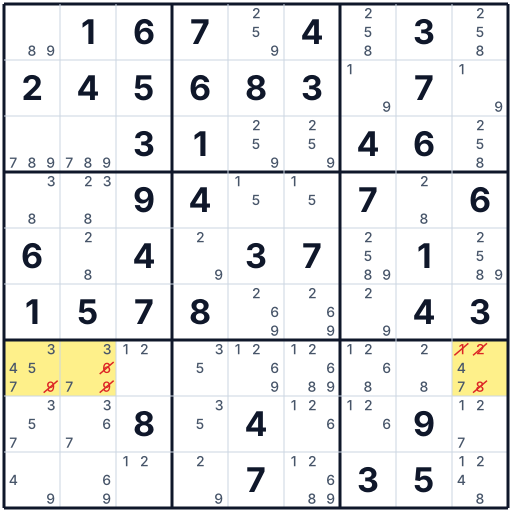
Example 3: There is a Hidden Quad in Row 9
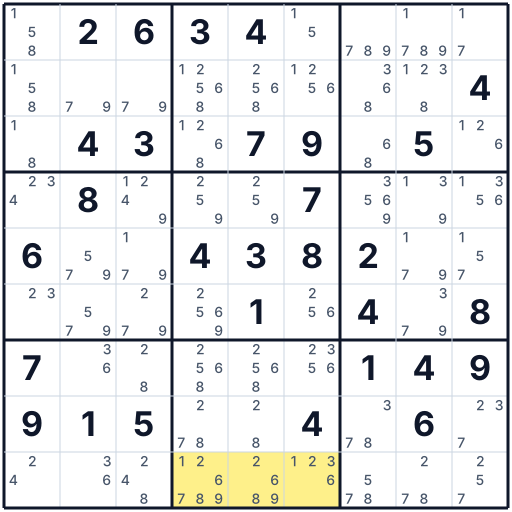
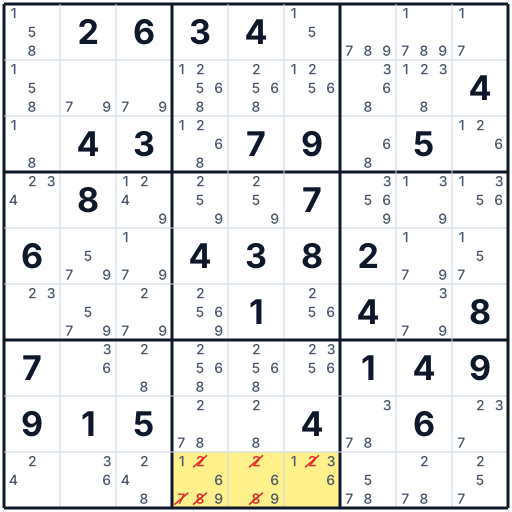
The quad is in row 9, which is fully open. The digits 1, 3, 6 and 9 appear only in r9c2, r9c4, r9c5 and r9c6. r9c2 is already {3,6}; the work is in the middle box, where r9c4 drops from six candidates to {1,6,9}, r9c5 goes from {2,6,8,9} to {6,9}, and r9c6 loses its 2. None of the five other cells in the row lists a 1, 3, 6 or 9, and checking that absence is how you confirm a hidden quad.
Why the deduction is valid
Four digits that can only be placed in the same four cells of a unit must occupy them, so every other candidate in those four cells is impossible. It is the largest of the hidden subsets and by far the rarest, because it requires four digits to be simultaneously restricted — a condition that usually resolves through some simpler technique first.
How to spot a Hidden Quad on your own board
- Tally which cells can hold each missing digit in the unit, then look for four digits whose combined footprint is exactly four cells.
- Expect to find it only in units with six or more empty cells, where the simpler subsets have not already cracked things open.
- In practice it is worth checking for a Hidden Quad only when a puzzle is genuinely stuck and every cheaper technique has been ruled out.
Common mistakes
- Reaching for it too early. If a Hidden Pair or an Omission is available, it will be faster and will often dissolve the quad before you need it.
- Forgetting the action is subtractive inside the four cells, not across the unit.
What to do next
The four cells become a Naked Quad once cleaned. Sweep the unit for singles and check whether the cells share another unit where the quad also applies.